MOTION CONTROL, FOOD, BEVERAGE & PRODUCT CINEMATOGRAPHY: BRINGING SPECIALIST COMMERCIAL DOP EXPERIENCE TO LONDON
There are plenty of things I'm looking forward to about moving from Los Angeles to London.
A new production community. New directors. New agencies. New crews. New studios. New locations.
Probably significantly less reliable sunshine.
But creatively, one of the things I'm most excited about is bringing the areas of commercial cinematography I've spent years working in to London and the wider UK production market.
My work as a Director of Photography has covered a pretty broad range, but there are a few areas I keep coming back to:
They're all slightly different worlds, but they're also much more connected than they initially appear.
All of them require precision. All of them require an obsessive eye for detail. And all of them involve making something that might be completely ordinary in real life look considerably more exciting once the camera starts rolling.
That's the kind of commercial DOP work I'm particularly excited to continue across London, Essex and throughout the UK.
WHY SPECIALIST COMMERCIAL CINEMATOGRAPHY MATTERS
There's a big difference between being able to photograph something and knowing how to photograph that particular thing well.
Food is a perfect example.
You can have a beautiful camera, great lenses and a fantastic lighting package, but none of that automatically makes food look delicious.
The same applies to beverages.
Or cosmetics.
Or reflective packaging.
Or a product that needs to move through frame at exactly the right moment while the camera passes it at speed.
Every commercial category has its own little rules.
Then, once you've learned all those rules, you occasionally get to break them.
You already understand where the problems are likely to appear.
And more importantly, you know how to solve them before everyone starts staring at the monitor wondering why something isn't quite working.
FOOD CINEMATOGRAPHY: MAKING PEOPLE HUNGRY IS THE JOB
I've shot a lot of food over the years.
Noodles.
Pizza.
Quesadillas.
Chocolate.
Snacks.
Sauces.
Ingredients.
Things falling.
Things flying.
Things exploding.
And an unreasonable number of things being dropped in slow motion.
Food cinematography is incredibly technical, but the final result can't feel technical.
That's the trick.
The audience shouldn't be thinking about the lighting.
They shouldn't be thinking about the lens.
They definitely shouldn't be thinking about the twelve people standing two metres away desperately trying to keep everything looking perfect.
They should just think:
I want that.
That's the job.
Great food cinematography is about texture, freshness, movement, colour and appetite.
Sometimes it's about capturing something incredibly simple, like the shine on a sauce.
Other times you're coordinating camera movement, special effects, food styling and high-speed photography so that an action lasting half a second becomes the hero moment of the commercial.
That's where years of experience as a food cinematographer become useful.
You start understanding how food behaves.
Or, more accurately, how badly food behaves when somebody points a camera at it.
FOOD CINEMATOGRAPHY IN LONDON AND THE UK
London has an enormous food scene and an equally strong advertising industry surrounding it.
Restaurants, packaged food brands, delivery companies, supermarkets, hospitality groups and consumer brands all need visual content that makes their products feel immediate and desirable.
That's something I'm excited to explore as a food cinematographer working in London and across the UK.
My approach isn't necessarily about making everything look overly perfect.
Often it's the opposite.
A little mess can make food feel real.
A sauce dripping slightly differently each time can be great.
Noodles don't always need to behave.
Actually, noodles rarely behave.
The important thing is knowing when the imperfection feels delicious and when it just looks like somebody dropped lunch.
There's a difference.
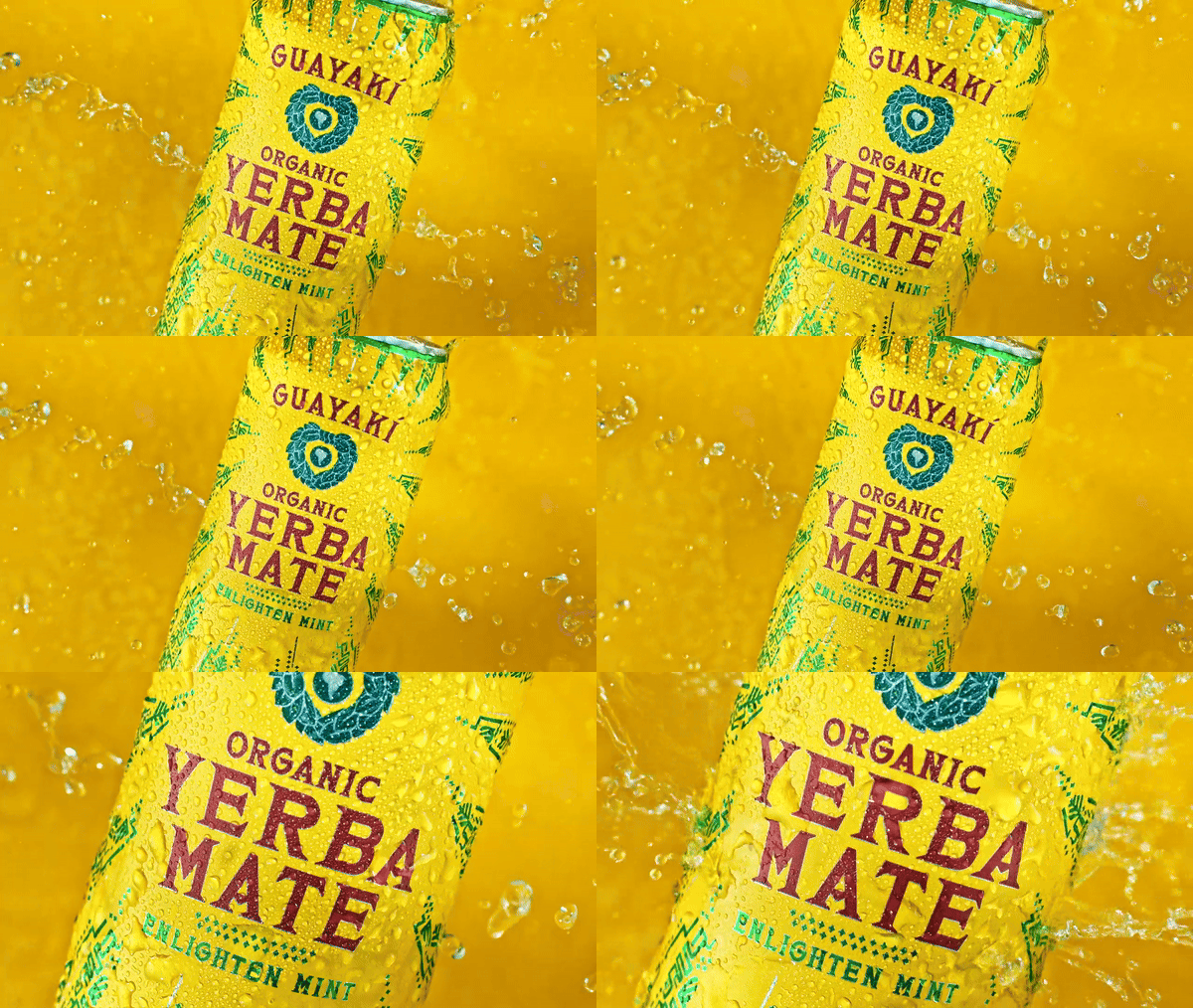
BEVERAGE CINEMATOGRAPHY: CONTROLLED CHAOS
Beverage cinematography introduces an entirely different collection of problems.
Glass.
Liquid.
Ice.
Reflections.
Condensation.
Bubbles.
Labels.
Transparency.
Splashes.
Basically, it's a category specifically designed to give cinematographers something to obsess over.
And I love it.
I've worked across wine, spirits, cocktails, energy drinks and other beverage campaigns, and every category needs its own visual personality.
Wine might need elegance and restraint.
A premium spirit may need deep contrast and beautifully controlled reflections.
An energy drink might need speed, impact and aggressive camera movement.
A refreshing drink might be all about condensation, ice and the perfect splash.
The lighting, lenses, movement and frame rate all need to reinforce that personality.
That's what makes beverage cinematography so much fun.
You're not simply photographing a bottle.
You're creating the feeling around it.
BEVERAGE CINEMATOGRAPHY IN LONDON
The UK has an incredible drinks market, from established global brands to independent spirits, breweries, mixers, wine companies and a growing world of premium non-alcoholic beverages.
For agencies and brands looking for a beverage cinematographer in London, the technical challenge is often making something incredibly controlled feel spontaneous.
That splash might have taken ten attempts.
The condensation might have been meticulously placed.
The camera move may have been programmed hours earlier.
The ice might not even be ice.
But none of that should matter when you watch it.
It should simply feel cold.
Refreshing.
Premium.
Or whatever emotion the brand needs.
That's where cinematography and advertising have to work together.
PRODUCT CINEMATOGRAPHY IS REALLY ABOUT PERSONALITY
Product cinematography is probably one of the broadest categories I work in.
I've shot beauty products, cosmetics, apparel, paint, toys, household products, packaged goods and plenty of objects that don't neatly fit into any of those categories.
And every product wants something different.
Beauty wants freshness.
Cosmetics often want texture and precision.
Apparel wants movement.
Paint needs accurate colour.
Luxury products need restraint.
Toys should probably be fun.
At least you'd hope so.
The interesting part of product cinematography is figuring out what the product's personality actually is.
Then everything starts building around that.
How should it move?
Should the camera move at all?
Should the lighting feel soft or graphic?
Should reflections be clean or expressive?
Do we want texture?
Do we want perfection?
Do we want the product to feel accessible or aspirational?
Those decisions are where the cinematography starts supporting the brand rather than simply documenting the object.
TABLETOP CINEMATOGRAPHY: WHERE MILLIMETRES MATTER
Tabletop sets can be deceptively funny places.
From across the studio, everything looks incredibly calm.
Then you walk closer and discover the entire shot depends on something being positioned three millimetres differently.
Nobody breathe.
Tabletop cinematography teaches you patience.
Tiny adjustments can completely change:
Reflections
Highlights
Shadows
Label visibility
Product shape
Background separation
Camera movement
The shot is often delicately balanced between multiple departments.
When it works, it looks effortless.
It absolutely was not.
MOTION CONTROL CHANGED THE WAY I SHOOT TABLETOP
Motion control has become one of the biggest parts of my commercial cinematography work.
And honestly, it's difficult to imagine certain projects without it now.
A motion control robot gives a cinematographer something incredibly valuable:
Repeatability.
Once a move is programmed, we can perform it again and again with extraordinary precision.
That opens up possibilities for:
Product cinematography
Food cinematography
Beverage cinematography
Visual effects
Multi-pass photography
Complex transitions
Precise camera choreography
Instead of hoping we can reproduce a difficult camera move manually, we know exactly where the camera is going.
Every time.
WHEN ONE ROBOT ISN'T ENOUGH
Some of my favourite motion control work has involved multi-pass cinematography and dual-robot setups.
Because apparently one giant robot moving around the set wasn't complicated enough.
With two motion control robots, you can synchronise different elements of the shot with incredible accuracy.
One robot might control the camera.
Another might control the product or action.
Or multiple passes can be captured separately and combined later.
That level of repeatability gives directors, cinematographers and VFX teams an enormous amount of creative freedom.
But there's an important distinction.
I don't use motion control because robots look impressive behind the scenes.
Although they definitely do.
I use motion control when it improves the shot.
The technology should serve the creative idea.
Never the other way around.
MOTION CONTROL CINEMATOGRAPHY IN LONDON
As I begin working more in the UK, motion control cinematography is one of the areas I'm particularly excited to continue developing.
London has a world-class advertising and commercial production industry, with brands and agencies constantly looking for ways to create images that stand out.
Motion control can be an incredibly powerful part of that.
Especially for:
Food advertising
Beverage commercials
Beauty campaigns
Cosmetics
Luxury products
Consumer goods
VFX-heavy advertising
Tabletop production
For brands or production companies looking for a motion control cinematographer or DOP in London, my approach will remain the same as it has been throughout my work in Los Angeles:
Start with the idea.
Then figure out whether the robot helps us make it better.
HIGH-SPEED CINEMATOGRAPHY AND MOTION CONTROL
Another area where motion control becomes particularly interesting is high-speed cinematography.
I've spent years working with Phantom cameras and slow-motion commercial photography.
At extremely high frame rates, tiny moments become entire sequences.
A splash.
A piece of food falling.
A bottle opening.
Powder exploding.
Liquid moving across a surface.
Suddenly an event that happens almost instantly becomes something the audience can actually explore.
Combine that with precise robotic camera movement and you get an entirely different visual language.
The camera isn't simply watching the action.
It's moving through it.
That's where high-speed and motion control cinematography can become incredibly powerful for food, beverage and product advertising.
WHY EXPERIENCE MATTERS ON SPECIALIST COMMERCIAL SHOOTS
The more technical the shoot becomes, the more important prep becomes.
When you're combining:
Motion control
Food styling
Special effects
High-speed cameras
Product movement
Lighting
VFX
Multiple passes
You really don't want to discover the fundamental problem at 4pm on shoot day.
Previsualisation becomes incredibly useful.
Testing becomes useful.
Conversations between departments become essential.
One of the biggest things I've learned throughout my career as a commercial Director of Photography is that complicated shots usually become much easier when everybody understands what they're trying to accomplish before arriving on set.
That sounds obvious.
You'd be surprised.
FROM LOS ANGELES COMMERCIAL DP TO LONDON COMMERCIAL DOP
I've been incredibly fortunate to build my career working within Los Angeles commercial production.
It's given me opportunities to experiment with technology, collaborate with some brilliant crews and work across an unusually broad range of advertising categories.
Now I'm excited to bring that experience into London.
Whether the job needs a food cinematographer, beverage cinematographer, product DOP, tabletop specialist or someone experienced with motion control cinematography, these are all areas I've spent years developing.
And I'll be working across London, Essex, England and throughout the UK as the right projects come along.
I also fully expect the move to introduce me to new techniques, new crews and new ways of doing things.
That's part of the appeal.
You never really finish learning cinematography.
COMMERCIAL CINEMATOGRAPHY IN LONDON: WHAT COMES NEXT?
The tools will continue changing.
Cameras will get better.
Robots will get faster.
Lighting will get smaller and somehow brighter.
AI will probably change parts of the workflow we haven't even considered yet.
But I don't think the fundamentals of great commercial cinematography are going anywhere.
Understand the product.
Understand the audience.
Understand the idea.
Plan carefully.
Surround yourself with talented people.
Then make the thing look as good as humanly possible.
That's what I've spent years doing as a Director of Photography in Los Angeles.
And it's exactly what I'm looking forward to continuing as a commercial DOP in London.
Food flying through the air?
Absolutely.
Wine looking ridiculously expensive?
Sure.
Beauty products floating through perfectly controlled light?
Let's do it.
Two robots performing an absurdly precise camera move around a product?
Now you're speaking my language.
London, I'm looking forward to seeing what we can make.