Commercial Cinematographer in London: What Brands, Agencies and Production Companies Should Look for in a DOP
Finding a commercial cinematographer in London isn't exactly difficult.
Finding the right one for a particular campaign is another story.
London has an enormous production community filled with talented cinematographers, Directors of Photography, DOPs and DPs working across advertising, television, branded content, fashion, music videos, food, beauty, automotive and just about every other category you can think of.
So how do you actually choose?
As I prepare to make the move from Los Angeles to London, it's something I've been thinking about from the other side too.
I've spent years working as a commercial Director of Photography in Los Angeles, collaborating with directors, agencies, production companies and brands across a pretty wide range of projects. Now I'm excited to bring that experience into the London and UK commercial production industry, while getting to know a completely new group of people along the way.
And whether you're hiring a DOP in London, Essex, elsewhere in England or anywhere across the UK, I think the fundamentals of what makes a good commercial cinematographer are fairly universal.
The reel matters.
Obviously.
But there's a lot more to the job than a collection of good-looking shots.

Start With the Work, But Look Beyond the Reel
The first thing anyone does when considering a Director of Photography is look at their work.
Makes sense.
You want to know whether they can create the kind of images your campaign needs.
But I think it's worth looking beyond whether a cinematographer's reel simply looks "cinematic."
What kind of problems have they solved?
Have they worked across different scales of production?
Can they shoot people as well as products?
Do they understand tabletop?
Can they handle complicated camera movement?
Do they know how to make food actually look edible?
Have they worked with celebrities or inexperienced on-camera talent?
Can they adapt when the original plan goes sideways?
Those questions often tell you more about a commercial DOP than whether every frame in their reel has beautiful backlight.
Commercial cinematography isn't one discipline.
A food commercial and a TV promo can require completely different approaches.
So can beauty, automotive, beverage, fashion and product advertising.
The more varied the campaign, the more valuable experience becomes.
A Good Commercial DOP Understands the Advertising Idea
One of the most important parts of being a commercial cinematographer is understanding that we're not making images in isolation.
We're helping sell an idea.
Sometimes we're literally helping sell a product.
The cinematography has to support that.
If I'm shooting a beauty campaign, the lighting needs to support the qualities the brand wants the customer to associate with the product.
If I'm shooting food, freshness and texture become incredibly important.
If I'm shooting an energy drink, maybe movement and intensity matter more.
If it's a television promo, character and performance might drive every camera decision.
That's why one of my first questions on any project is essentially:
What are we trying to make the audience feel?
Everything else starts there.
Camera.
Lenses.
Lighting.
Movement.
Color.
Texture.
Frame rate.
Motion control.
All of those are tools.
The creative idea comes first.
Look for a Cinematographer Who Knows How to Prep
People love talking about what happens on set.
The big lights.
The cameras.
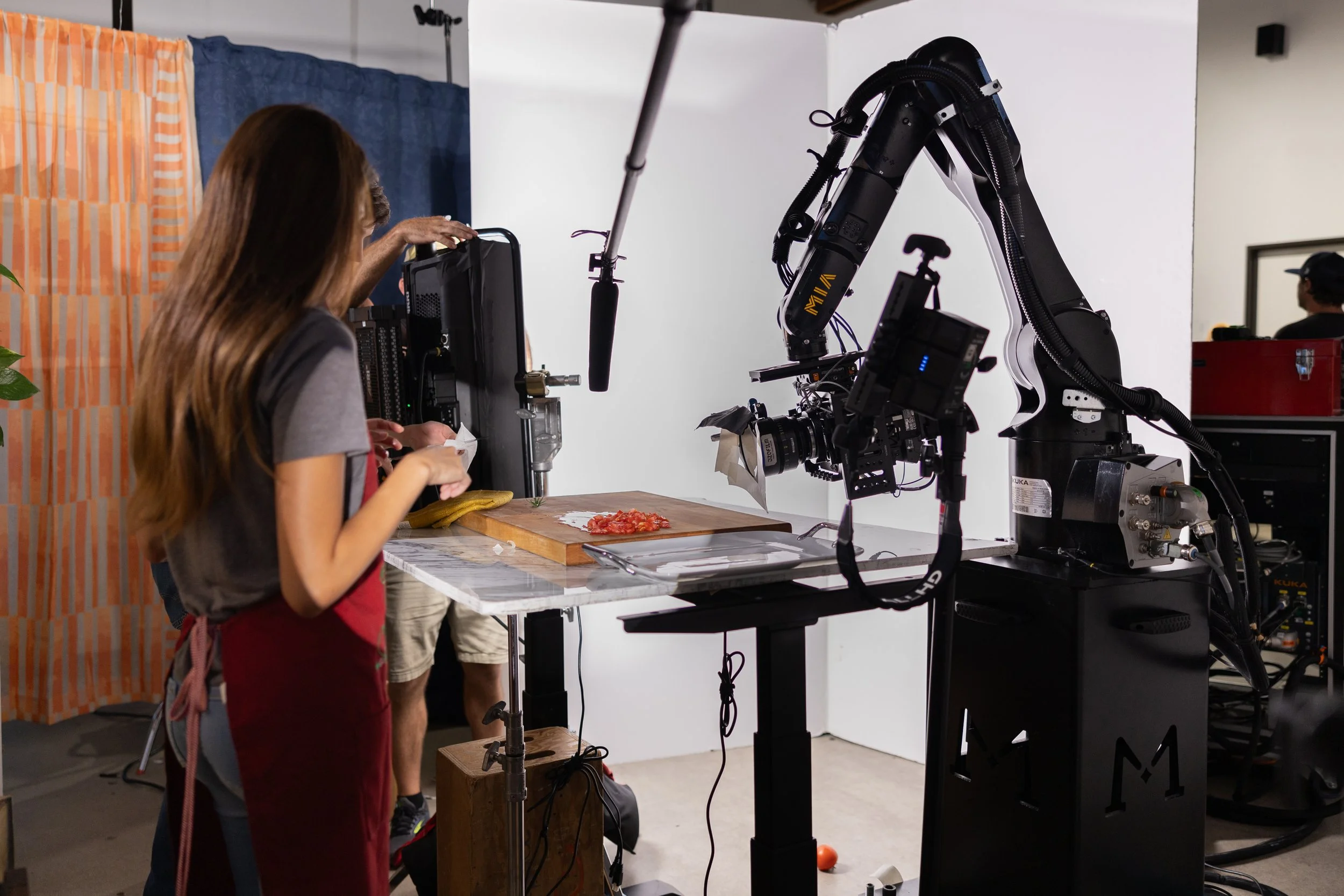
The robot arms.
The ridiculous rigs.
The crew running around.
The monitor where everyone gathers and starts saying things like, "Can we make it feel 10% more energetic?"
But a huge part of a Director of Photography's job happens before any of that.
Prep is everything.
Depending on the project, that might include:
* Creative calls with the director
* Treatments and visual references
* Storyboards
* Previsualisation
* Technical scouts
* Camera tests
* Lens tests
* Lighting plans
* Motion control programming
* VFX conversations
* Production design coordination
* Special effects testing
* Shot prioritisation
I've become a huge believer in previsualisation, particularly for complicated commercial work.
The more difficult the shot, the more valuable it becomes to solve problems before the clock starts running on shoot day.
That's particularly true for motion control cinematography, tabletop production, food and beverage work, high-speed cinematography and VFX-heavy advertising.
Good prep doesn't remove spontaneity.
It gives you more room for it.
When everyone understands the plan, you're much better positioned to abandon it intelligently when something better happens.
Commercial Cinematography Is Mostly Problem-Solving
There's a lot of glamour associated with being a DP or DOP.
Then you actually do it.
Suddenly you're discussing whether a reflection needs to move two centimetres to the left while someone is spraying glycerin onto a bottle and another person is holding a piece of black card just outside frame.
Very glamorous.
The reality is that commercial cinematography involves constant problem-solving.
The sun moved.
The talent's late.
The product isn't behaving.
The location doesn't look like it did on the scout.
The food is dying.
The liquid isn't splashing correctly.
A reflection appeared.
The robot needs recalibrating.
The schedule just lost an hour.
Something that worked perfectly during testing has suddenly decided it no longer believes in teamwork.
That's production.
A good London DOP needs to be able to adapt without allowing every little problem to become everybody else's problem.
That's something experience teaches you.
Sometimes the technically perfect solution isn't the right solution.
Sometimes you need the solution that gets the shot, protects the schedule and keeps the production moving.
Versatility Matters in Commercial Production
I've always enjoyed moving between very different types of cinematography.
Over the years, my work has included:
*Beauty and cosmetics**
*Tabletop cinematography**
*Motion control**
*Automotive work**
*People-driven advertising**
*High-speed Phantom cinematography**
Every category teaches you something useful for another.
Food teaches you timing and texture.
Beverage work teaches you reflections, transparency and controlled chaos.
Product cinematography teaches precision.
Motion control teaches planning.
People teach you that sometimes the technically perfect frame doesn't matter if the person inside it doesn't feel comfortable.
TV promos teach you to move quickly.
Automotive cinematography teaches you to plan movement at scale.
Those skills start overlapping.
That's why when a brand, agency or production company is searching for a commercial cinematographer in London or the UK, I'd look at range as well as specialisation.
The two don't have to be opposites.
Your DOP Should Understand Modern Deliverables
This has become increasingly important.
Commercial campaigns aren't just being made for one television spot anymore.
A single shoot might need to create material for:
* Broadcast
* YouTube
* Websites
* TikTok
* Paid social
* Digital advertising
* Retail displays
* E-commerce
* Vertical video
* Behind-the-scenes content
That changes how a Director of Photography approaches the shoot.
A beautiful 16:9 composition isn't particularly helpful if somebody discovers afterwards that the campaign's biggest media buy is vertical and the product disappears when the shot gets cropped.
Modern commercial cinematography in the UK needs to account for how the images will actually be used.
That might affect composition.
It might affect camera movement.
It might mean capturing alternate takes.
It might require additional clean plates.
It might mean deliberately creating negative space for copy.
None of these decisions are particularly glamorous.
They're also the kind of decisions that can save everyone a massive headache later.
Collaboration Might Be the Most Important Skill
Nobody makes commercial work alone.
The cinematography only works because it's surrounded by great people.
Directors.
Producers.
Gaffers.
Grips.
Production designers.
Art departments.
Food stylists.
Special effects teams.
VFX supervisors.
Camera crews.
Robot operators.
Editors.
Colorists.
And plenty of people I've inevitably forgotten while writing this.
One thing I've learned throughout my career in Los Angeles is that the best productions usually aren't the ones where one person had every answer.
They're the ones where everyone contributed something.
That's especially true for a DOP.
My responsibility is to protect the visual language of the project, but that doesn't mean pretending I have the only good idea on set.
Quite the opposite.
A great gaffer will see something I don't.
A production designer might completely change what's possible with a frame.
A grip might solve a problem in five minutes that I've been thinking about for twenty.
A food stylist can tell me when we're about to miss the tiny window where something looks perfect.
Good cinematography is collaborative.
And I don't expect that to be any different working with crews in London, Essex or elsewhere across England and the UK.
Experience Becomes More Valuable When Time Gets Tight
Commercial production has changed.
There are more deliverables.
Turnarounds are faster.
Budgets are under pressure.
And expectations haven't exactly gotten smaller.
That's where an experienced Director of Photography becomes particularly valuable.
The job isn't always figuring out the most elaborate way to accomplish something.
Often it's knowing where the production value actually matters.
Where should we spend our time?
Where can we simplify?
Which setup needs another twenty minutes?
Which shot is already working and needs everyone to stop touching it?
That's experience.
Sometimes being a good DOP means knowing when to keep pushing.
Sometimes it means saying:
We've got it. Move on.
On a busy commercial set, that might be one of the most valuable decisions anyone makes all day.
Finding the Right Commercial Cinematographer in London
So what should an agency, director, producer or brand actually look for when hiring a commercial DOP in London?
I'd boil it down to a few things.
Taste.
Do you like their work?
Relevant experience.
Have they solved problems similar to yours?
Technical knowledge.
Can they execute the idea properly?
Preparation.
Do they think ahead?
Adaptability.
Can they respond when reality ignores the storyboard?
Collaboration.
Can they work well with the director, agency, client and crew?
Efficiency.
Can they protect quality without destroying the schedule?
Curiosity.
Are they still interested in trying something new?
That last one matters to me.
I've been doing this for a long time, but I'm still interested in new cameras, new lighting, new motion control technology, new techniques, AI workflows and whatever strange piece of equipment somebody brings onto set next.
You should never stop learning this job.
The industry certainly isn't going to stop changing for you.
## From Los Angeles DP to London DOP
Moving from Los Angeles to London is obviously a major transition for me.
I've spent years building relationships and working within the Los Angeles commercial cinematography world, and I'm incredibly grateful for everything that experience has given me.
Now I'm looking forward to bringing it to a new market.
I'll be working across London, Essex and throughout the UK, with a particular focus on the commercial categories I've spent much of my career shooting:
Food. Beverage. Products. Beauty. Tabletop. Motion control. TV promos. People. Automotive. Advertising.
I'm also looking forward to working with new directors, advertising agencies, creative teams and production companies throughout England.
Different city.
Different production community.
Slightly different job title.
Same obsession with getting the shot right.
Whether you want to call me a cinematographer, Director of Photography, DP or DOP, I'm pretty easy on that part.
Just don't ask me to choose between the 25mm and the 50mm until I've had coffee.
Looking for a Commercial DOP in London or the UK?
If you're planning an upcoming commercial video production in London, Essex or elsewhere in the UK, the most important thing isn't finding a cinematographer who approaches every project the same way.
It's finding someone who understands what your project needs.
Sometimes that's naturalistic handheld cinematography.
Sometimes it's beautiful controlled lighting.
Sometimes it's high-speed food flying through the air.
Sometimes it's a luxury bottle surrounded by carefully controlled reflections.
And sometimes it's two motion control robots doing something that sounded completely unreasonable during the first creative call.
That's what keeps this job interesting.
After years as a commercial Director of Photography in Los Angeles, I'm excited to start bringing that experience to London's advertising and production community and see what we can create together.
New city.
Plenty of new shots to figure out.