Los Angeles has no shortage of cinematographers.
You could probably throw a lens cap in any direction and hit three DPs, two directors, and somebody who just bought an ARRI Alexa and is figuring out what to do with it.
But finding the right Director of Photography for a commercial campaign is a different story.
I've spent years working as a commercial DP in Los Angeles, shooting everything from food and beverage advertising to beauty products, tabletop commercials, television promos, and projects involving motion control robots and high-speed cameras.
Some shoots involve massive crews, complicated lighting setups, and weeks of planning. Others involve a director, a camera, and a very early sunrise.
Both can produce incredible work.
The trick is knowing what the project actually needs.
If you're an agency producer, creative director, brand, or production company looking to hire a commercial Director of Photography in Los Angeles or elsewhere in California, here are a few things worth considering before making that call.

1. Look Beyond the Cinematographer's Showreel
A great reel is important.
Obviously.
It's the quickest way to understand a cinematographer's visual style, technical abilities, and the kind of work they've been involved in.
But a beautiful reel doesn't necessarily tell you everything you need to know.
Commercial cinematography covers an enormous range of specialties.
Someone who's brilliant at shooting dialogue-heavy commercials might have very little experience photographing liquids, reflective products, or complicated tabletop sequences.
A cinematographer who specializes in automotive advertising might be excellent with moving vehicles and large exterior productions but less familiar with the particular challenges of food styling and high-speed product photography.
And that's perfectly fine.
Nobody needs to be brilliant at absolutely everything.
Look for relevant work, not just impressive work.
And if you see something interesting in their portfolio, ask how they actually shot it.
That conversation can tell you considerably more than a sixty-second montage.
2. Commercial Cinematography Is About Understanding the Advertising Idea
One of the biggest differences between commercial cinematography and other forms of filmmaking is the relationship between the images and the message.
We're not simply trying to make something beautiful. We're trying to communicate something. Sometimes that's the freshness of a food product. Sometimes it's the premium quality of a beverage. Sometimes it's the personality of a brand, the benefits of a product, or the humor behind a television promo.
The cinematography needs to support that idea.
I've worked on food and beverage campaigns where the entire success of a shot depends on making something look genuinely delicious. I've also worked on HBO promotional campaigns where the visual style needed to support comedy, performance, and a very particular tone. Those require completely different approaches.
For HBO's A Knight of the Seven Kingdoms promotional project, A Squire for Hire, we leaned into a loose, mockumentary-style visual language.
Handheld movement, snap zooms, and an intentionally imperfect camera style were part of the joke.
That was exactly what the project needed.
Would I shoot a premium cosmetics commercial that way?
Probably not.
Unless somebody had a particularly interesting idea.
A good commercial Director of Photography understands that the creative concept comes first. The lighting, lenses, movement, and camera package should all follow from there.
3. Specialist Experience Matters in Food, Beverage & Product Advertising
Los Angeles is home to a huge range of commercial productions, from large brand campaigns to highly specialized tabletop shoots.
And some of those specialties are considerably more technical than they appear.
Take food cinematography.
Making pizza look delicious sounds simple until you're trying to capture the perfect cheese pull, steam, sauce movement, and camera move simultaneously.
Glass reflects everything. Ice moves. Condensation disappears. Liquids have absolutely no interest in following your carefully planned shot list.
I've worked on campaigns involving brands such as Pei Wei, Absolut x Ocean Spray, Banfi, and many others where those tiny details become the entire focus of the shoot.
Product cinematography introduces another set of challenges.
Cosmetics, skincare, household products, reflective packaging, and luxury items all respond differently to light.
Sometimes a tiny adjustment to a reflection changes the entire image.
And when I say tiny, I mean a few millimeters.
It's one of the reasons tabletop cinematography can be so time-consuming.
From across the studio, it might look like we're standing around doing nothing.
We're not.
We're just having a very serious discussion about a highlight.
If you're an advertising producer hiring a Los Angeles cinematographer for a specialist product campaign, make sure their experience goes beyond general commercial production.
The right technical background can save a surprising amount of time on set.
4. Know When You Need Motion Control or High-Speed Cinematography
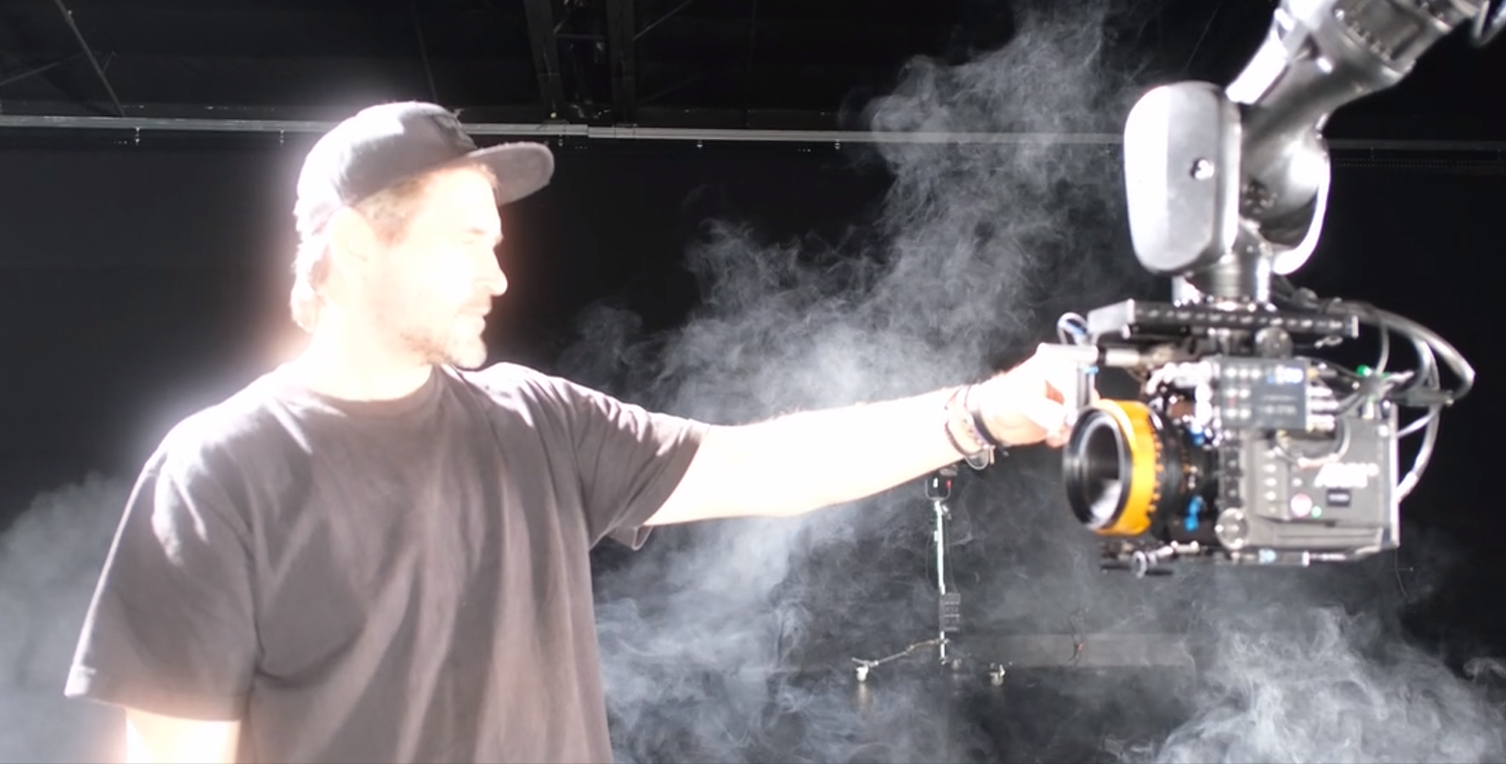
Motion control has become a significant part of my work as a commercial DP.
I've spent years working with robotic camera systems, including complex tabletop setups, repeatable camera movements, and shoots involving multiple robots.
The biggest advantage of motion control cinematography is precision.
Once a move is programmed, we can repeat it consistently.
That's incredibly useful when you're shooting multiple passes, coordinating product movement, capturing high-speed action, or creating footage that will be combined with visual effects.
High-speed cinematography opens up another world entirely.
With Phantom cameras, moments that normally happen in fractions of a second become entire sequences.
A splash.
A burst of powder.
A piece of food flying through the air.
Liquid moving around a product.
These are the kinds of shots where technical planning really matters.
But I don't think every commercial needs a robot.
Or a Phantom.
Or the biggest camera package available.
Sometimes the best solution is a simple camera move and a really good lighting setup.
When hiring a motion control cinematographer in Los Angeles, I'd look for someone who understands when the technology genuinely improves the idea.
Not someone who's determined to use it because it looks impressive in the behind-the-scenes footage.
Although, admittedly, the robots do look pretty cool.
5. Pre-Production Is Where a Lot of the Important Decisions Happen
One of the things I've learned over the years is that a successful shoot usually starts well before anybody calls action.
Especially when you're dealing with complicated commercial production.
I like to understand the creative treatment, the visual references, the production schedule, the locations, and the practical limitations before we get to set.
What are the most technically demanding shots?
Are there special effects?
Will we need multiple passes?
Does the product have difficult reflective surfaces?
Are we working with celebrity talent and limited availability?
What formats does the agency need?
And how many setups are we realistically trying to fit into the day?
For technically complicated projects, previsualization and testing can make an enormous difference.
The more departments involved, the more valuable those conversations become.
On a food commercial, that might mean coordinating with the food stylist and special effects team.
On a motion control shoot, it could mean working closely with the robot operator, engineer, and VFX team.
On a television promo, it might involve planning how to capture multiple setups while keeping the performances spontaneous.
As a Director of Photography, I want to identify potential problems early enough that we can actually do something about them.
Preferably before everyone is standing around waiting for the camera department.
6. The Best Commercial DPs Know How to Collaborate
Commercial production is a team sport.
Even when a shot looks incredibly simple, there's usually a talented group of people making it happen.
Directors, producers, agency creatives, gaffers, grips, camera assistants, art departments, food stylists, special effects teams, and plenty of other specialists.
My job as a cinematographer is to help translate the creative vision into images while making sure the technical side of production supports that vision.
That requires communication.
And occasionally knowing when to stop talking and listen.
I've been fortunate to work with some fantastic directors and crews throughout Los Angeles and California.
Those relationships matter.
When everyone understands what we're trying to achieve, the entire production moves more efficiently.
And when something inevitably goes wrong, having a crew that can adapt makes all the difference.
7. A Los Angeles DP Should Be Comfortable With Different Production Scales
Not every commercial needs a thirty-person crew.
And not every commercial should be attempted with two people and a backpack.
I've worked at both ends of that spectrum.
For a Madison Energy Infrastructure project, director Allen Colombo and I travelled through facilities in Los Angeles, Bakersfield, San Francisco, and Virginia with a remarkably small setup.
Just the two of us, an ARRI Alexa Mini LF, vintage Canomatic Prime lenses, and a DJI Mavic 3 drone.
We relied on natural light, composition, timing, and the ability to move quickly.
At one location near Washington, DC, drone restrictions meant we needed another way to capture an elevated perspective.
So we used a 150-foot lift.
Problem solved.
I've also worked on much larger productions involving extensive lighting, multiple cameras, motion control systems, and specialized crews.
The approach depends on the job.
For advertising agencies and production companies hiring a commercial cinematographer in California, flexibility is valuable.
You want a DP who understands what resources are necessary to achieve the creative, rather than approaching every project with exactly the same production model.
8. Think About the Final Deliverables Before Choosing Your Camera Approach
Commercial campaigns rarely live in just one format anymore.
An agency might need a hero film, shorter edits, social media versions, vertical video, product-specific cutdowns, and additional assets for digital advertising.
That affects cinematography.
A beautifully composed widescreen shot might not crop particularly well for vertical delivery.
A complex camera move could be perfect for a thirty-second commercial but difficult to use in a six-second edit.
And a product reveal might need additional coverage to give the editor more options.
These are things worth discussing before production begins.
As a commercial DP, I want to understand where the footage will end up.
Not because every shot should be designed by committee.
But because a little planning can make the finished material significantly more useful.
Great cinematography should look good.
It should also work for the campaign.
Ideally, both.
9. Questions to Ask Before Hiring a Commercial Cinematographer in Los Angeles
If you're putting together a shortlist of Directors of Photography for an advertising campaign, here are a few questions I'd recommend asking.
Have you shot campaigns with similar creative or technical requirements?
Look for relevant experience rather than relying entirely on the showreel.
What do you see as the biggest challenge in our treatment?
This can reveal how a cinematographer thinks through production problems.
How would you approach the lighting and camera movement?
The answer should connect back to the creative idea.
Would you recommend specialized equipment?
Motion control, high-speed cameras, drones, and other tools can be valuable when there's a good reason to use them.
What should we test or prepare before the shoot?
An experienced DP should be able to identify areas where preparation will save time.
How do you approach working with directors, agency creatives, and other departments?
Technical ability matters, but collaboration is just as important.
Can you adapt to our production schedule and budget?
The best cinematography approach is one that can actually be executed with the resources available.
None of these questions needs a particularly complicated answer.
But the conversation will usually give you a pretty good sense of whether the cinematographer is the right fit.
10. Commercial Cinematography in Los Angeles & Across California
Los Angeles is an incredible place to work as a Director of Photography.
There's a huge concentration of creative talent, production companies, advertising agencies, studios, equipment, and specialized crews.
And the range of projects is enormous.
One week might involve a food commercial with high-speed photography and motion control.
Another might be a cosmetics campaign with carefully controlled tabletop lighting.
Then a television promo, a beverage commercial, or an industrial production somewhere in California.
That's one of the things I've always enjoyed about commercial cinematography.
No two projects are quite the same.
My experience as a Los Angeles DP spans food and beverage advertising, product and beauty cinematography, tabletop production, motion control, high-speed photography, television promos, and branded entertainment.
And while every project presents different challenges, my approach is pretty consistent.
Understand the idea.
Figure out what the images need to communicate.
Plan the complicated stuff.
Work with good people.
And make the final result look as good as possible.
If you're an advertising agency, director, producer, or brand looking for a commercial Director of Photography in Los Angeles, a California cinematographer, or a specialist DP for food, beverage, product, or motion control advertising, I'd love to hear what you're working on.
Especially if the shot sounds a little complicated.
Those tend to be the interesting ones.
Frequently Asked Questions About Hiring a Commercial DP in Los Angeles
What does a commercial Director of Photography do?
A commercial Director of Photography, also known as a DP or cinematographer, is responsible for the visual execution of an advertising production. This includes camera and lens choices, lighting, composition, camera movement, and collaboration with the director and production crew.
How do I choose the right cinematographer in Los Angeles?
Look for a commercial DP whose portfolio demonstrates experience with the type of advertising you're producing. Review relevant projects, discuss the creative treatment, and ask about their technical approach, collaboration style, and production experience.
What's the difference between a DP and a cinematographer?
In commercial production, Director of Photography, DP, and cinematographer are generally used interchangeably. All three refer to the person responsible for leading the cinematography and visual execution of a production.
Do commercial cinematographers specialize in particular types of advertising?
Yes. Some cinematographers specialize in automotive, fashion, narrative, or lifestyle advertising, while others focus on food, beverage, beauty, tabletop, product cinematography, or technically complex shoots involving motion control and high-speed cameras.
When should a commercial production use motion control cinematography?
Motion control is particularly useful for repeatable camera movements, product reveals, multi-pass photography, synchronized effects, and shots requiring precise camera choreography. It can be especially valuable in tabletop, food, beverage, and product advertising.
Is Drew Lauer available for commercial cinematography projects in Los Angeles and California?
Yes. I work as a commercial Director of Photography in Los Angeles and on productions throughout California, specializing in food, beverage, beauty, product, tabletop, motion control, high-speed cinematography, and branded entertainment.