I've spent a pretty significant amount of my career making food and drinks do things they probably weren't designed to do.
Pizza cutters flying through pizzas. Noodles being lifted into the air. Liquids splashing in carefully controlled directions. Bottles rotating through elaborate camera moves. Ingredients falling, spinning, pouring, and occasionally refusing to cooperate with absolutely anyone on set.
It's a strange job when you think about it. But I love it.
As a commercial Director of Photography in Los Angeles, food and beverage cinematography has become one of my favorite areas of filmmaking. There's something particularly satisfying about taking an everyday product and turning it into an image that makes somebody immediately hungry, thirsty, or curious enough to stop scrolling.
Over the years, I've worked on food and beverage advertising for brands including Pacifico, Absolut x Ocean Spray, Banfi, Maggi, El Pollo Loco, Pei Wei Asian Kitchen, and Round Table Pizza, among others. Every campaign comes with its own challenges, but the fundamentals are surprisingly consistent: understand the product, find what makes it appealing, and figure out the most interesting way to capture it.
Sometimes that's a simple, beautifully lit close-up. Other times it involves a Phantom high-speed camera, a motion control robot, and a crew of people carefully coordinating something that happens in less than a second.
Both approaches have their place.
Food Cinematography Is About Making People Hungry
The goal of food cinematography sounds simple enough. Make the food look delicious. But actually achieving that requires a lot more than pointing a camera at a good-looking plate.
Food is incredibly sensitive to lighting, temperature, movement, and timing. A dish might look fantastic when it first arrives on set, but things can change quickly once the lights are on and the camera starts rolling. Sauces move, steam disappears, ingredients settle, and the perfect piece of food can suddenly look considerably less perfect.
That's why food cinematography is such a collaborative process. The Director of Photography, director, food stylist, art department, and special effects team all need to understand exactly what we're trying to capture. A tiny adjustment to the lighting can completely change the way a sauce looks, while a small change in camera angle can make the difference between a shot that feels delicious and one that simply documents what's on the plate.
I've worked on campaigns involving everything from noodles and pizza to quesadillas, shrimp, sauces, and snacks. Each product has its own visual personality. Noodles need movement and texture. Pizza often benefits from warmth, cheese, and a little mess. Fresh ingredients need color and energy, while something like chocolate might call for slower, more controlled photography.
From Maggi Noodles to Round Table Pizza and El Pollo Loco
One of the things I enjoy about food advertising is how different the creative challenges can be from one campaign to another.
For Maggi, noodles become the hero. It's about texture, movement, and making something familiar feel incredibly appetizing. When you're working with noodles, timing and camera position can make a huge difference. You want the viewer to appreciate the movement and texture without the whole thing becoming a tangled mess.
Although sometimes the tangled mess is exactly what makes it look delicious.
On Round Table Pizza, we used motion control to create a shot involving a pizza cutter moving through chicken pizzas. It's the kind of sequence that looks straightforward in the finished commercial but requires careful coordination between camera movement, the physical action, and the food itself. When everything comes together, the result feels effortless, even if the process behind it was anything but.
I've also worked on food campaigns for El Pollo Loco, including quesadilla-focused imagery where texture, warmth, and appetite appeal are central to the shot. With food like this, you want the viewer to practically imagine what it tastes like. The cinematography needs to emphasize the ingredients and the way they interact rather than simply presenting a finished product.
And then there are projects like Pei Wei Asian Kitchen, where vibrant ingredients, sauces, and movement create opportunities for more dynamic food cinematography. It's a category where high-speed photography, close-up detail, and thoughtful lighting can really bring the product to life.
Every brand needs a different approach, but the objective remains the same. Make somebody watching the commercial wish the food was sitting in front of them.
Beverage Cinematography: Glass, Liquids, Reflections and a Lot of Patience
Beverage cinematography introduces an entirely different collection of problems.
Glass reflects everything. Liquids are unpredictable. Ice moves. Condensation disappears. Labels need to remain readable, and sometimes the most important part of the shot is a splash that lasts less than a second.
It's a wonderful collection of things that can go wrong.
But that's also what makes beverage advertising so interesting to shoot.
I've worked on beverage campaigns involving beer, wine, spirits, cocktails, and other drinks, including projects for Pacifico, Absolut x Ocean Spray, and Banfi. Each brand has its own visual language, and the cinematography needs to reflect that.
A premium wine commercial might call for elegant camera movement, carefully controlled highlights, and a more restrained lighting approach. A cocktail or spirits campaign might benefit from stronger contrast, richer colors, and more dynamic liquid photography. Beer advertising often leans into refreshment, condensation, atmosphere, and the feeling surrounding the drink.
The lighting is particularly important. When you're photographing glass, you're often lighting the reflections as much as the bottle itself. Small adjustments can change the entire shape and character of the product, and getting the label, liquid, and highlights working together requires a fair amount of precision.
For agencies looking to hire a beverage cinematographer in Los Angeles, that's one of the biggest things I'd recommend considering. Beverage cinematography is a specialty, and experience with reflective surfaces, liquid movement, and tabletop lighting can make a significant difference to the final result.
Shooting Pacifico, Absolut x Ocean Spray and Banfi
Different beverage brands offer completely different creative opportunities, which is one of the reasons I enjoy working in the category.
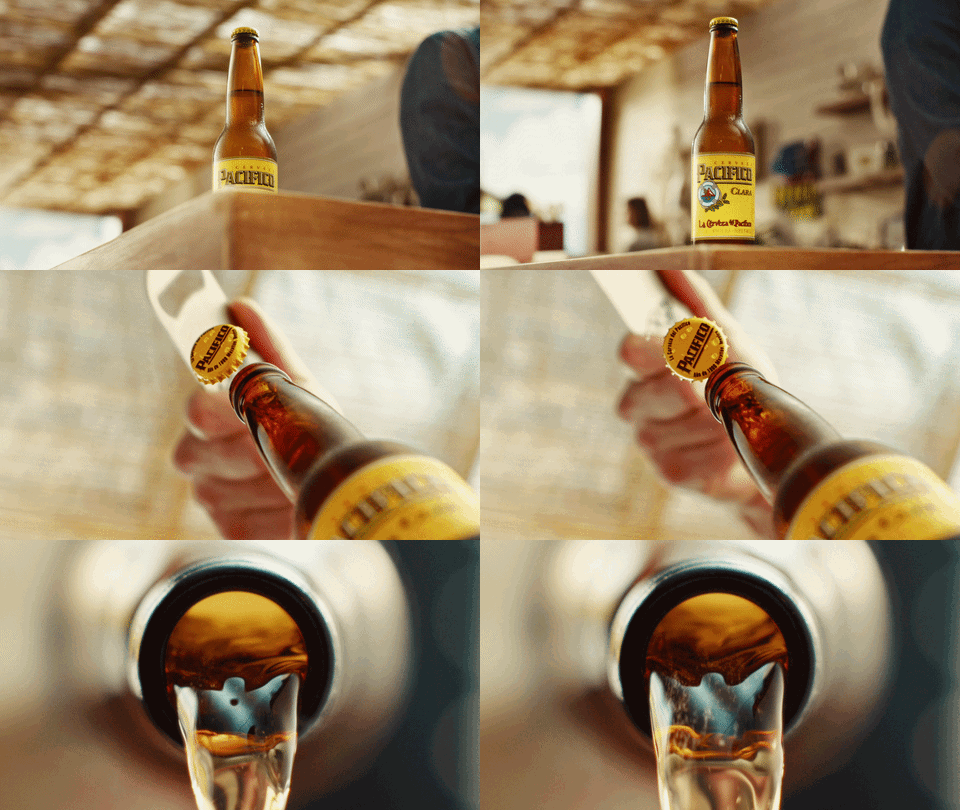
For Pacifico, the campaign was built around the idea that the best things are worth searching for. That creates a different kind of visual challenge from a straightforward studio product commercial. The cinematography needs to contribute to the feeling of discovery and the world surrounding the brand, rather than focusing exclusively on the bottle.
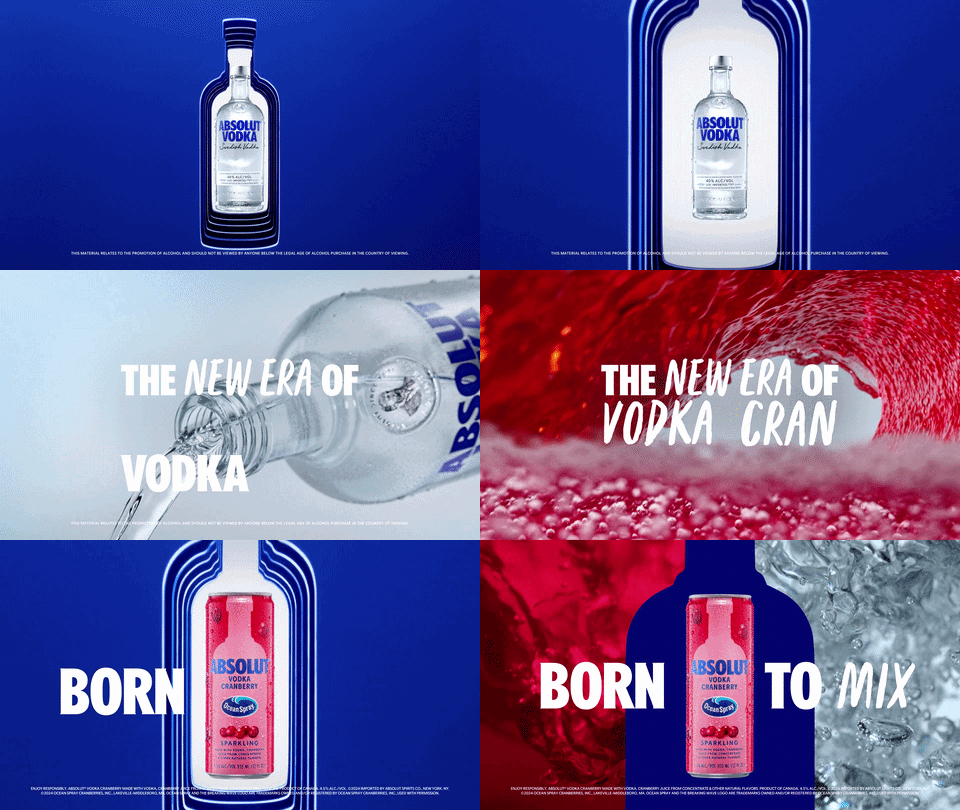
With Absolut x Ocean Spray, the familiar vodka cranberry becomes an opportunity to explore color, liquid movement, and the visual personality of the drink. Beverage cinematography can make even a simple combination feel exciting when the lighting, camera movement, and physical action work together.
For Banfi, the approach leans toward a more premium visual style. Wine cinematography is often about restraint, beautifully controlled reflections, and creating an atmosphere that communicates quality without making the imagery feel overly complicated. I've also worked on slow-pour beverage imagery for Banfi with director Timothy Hogan, where the movement of the liquid becomes an important part of the visual experience.
That's what I find interesting about beverage advertising. You can photograph several different bottles in the same studio with the same camera, and the creative approach should still feel completely different for each brand.
The product might be the subject, but the personality comes from the cinematography.
High-Speed Food and Beverage Cinematography: Making a Split Second Count
High-speed cinematography is one of the most useful tools for food and beverage advertising because so much of what makes these products visually interesting happens incredibly quickly.
A splash, a pour, a burst of ingredients, or a piece of food falling through frame might only last a fraction of a second in real time. With a Phantom high-speed camera, we can slow those moments down and reveal details that would otherwise be almost impossible to appreciate.
Suddenly, a splash becomes an entire sequence. Liquid takes on sculptural shapes, ingredients move through the air, and tiny details become the focus of the shot.
But high-speed cinematography comes with its own challenges. Shooting at extremely high frame rates requires more light, careful timing, and a good understanding of how the action will behave. There's also the practical side of resetting the shot, especially when liquids or food are involved.
Some effects are repeatable. Others have their own ideas.
That's where experience and preparation become important. I like working closely with the director, food stylist, special effects team, and camera crew to figure out exactly what needs to happen and how we can give ourselves the best chance of capturing it.
For food and beverage brands, high-speed cinematography can create memorable hero moments that work particularly well in television commercials, digital advertising, and short-form social content.
The trick is making sure those moments still communicate something about the product rather than simply looking impressive in slow motion.
Motion Control Cinematography for Food and Beverage Commercials
Motion control is another major part of my work as a Los Angeles commercial DP, and it's particularly useful in food, beverage, and tabletop advertising.
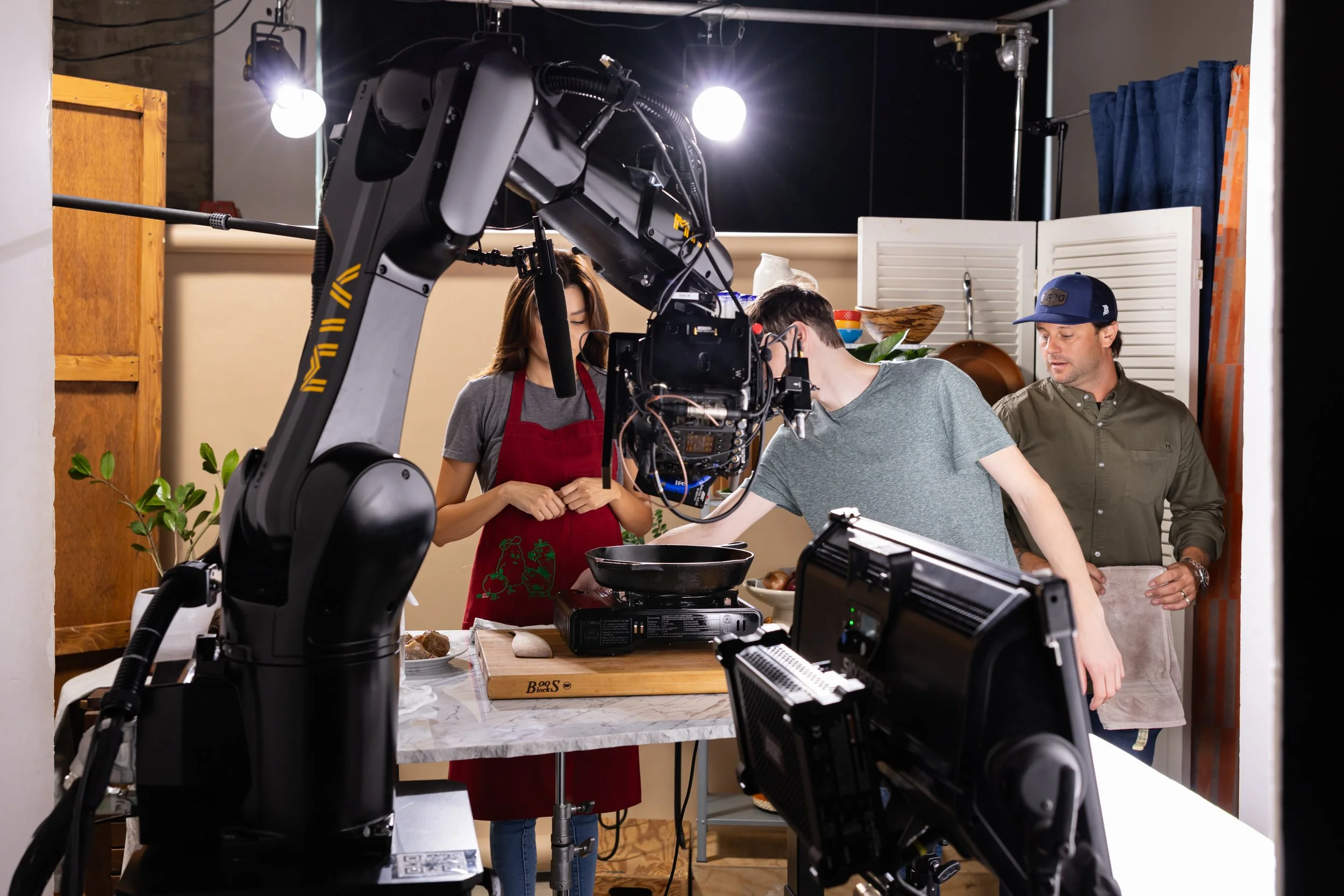
A motion control robot allows us to create precise, repeatable camera movements. Once a move is programmed, we can perform it consistently, which becomes incredibly valuable when coordinating food movement, liquid effects, multiple passes, or visual effects.
I've worked with motion control systems on a wide range of commercial projects, including setups involving two robots working together. On a cherry pie tabletop shoot at Hudson Studio with Timothy Hogan Studio, we used a dual-robot setup to capture detailed close-ups and carefully coordinated movement.
It's the kind of production where the camera, product, and physical action all need to work together with very little room for error.
Motion control also gives us opportunities to approach familiar products in more interesting ways. Instead of simply watching a pour or a piece of food moving through frame, we can move the camera around the action with a level of precision that would be difficult to achieve manually.
Of course, not every food or beverage commercial needs a robot. Sometimes a simple camera move is exactly what the idea calls for. But when the creative involves complicated movement, precise timing, or visual effects, motion control can open up some pretty exciting possibilities.
And yes, having a giant robot on set is still fun.
Why Pre-Production Matters on Food and Beverage Shoots
One thing I've learned from years of food and beverage cinematography is that the more effortless a shot looks, the more planning may have gone into it.
When a commercial involves food styling, liquids, high-speed photography, motion control, or practical effects, there are a lot of moving parts. The director, cinematographer, food stylist, art department, robot operator, special effects team, and VFX crew may all need to coordinate around a single shot.
That's why I like to work through the complicated elements during pre-production. What exactly is the hero moment? How will the product move? Does the action need to be repeatable? Are we capturing multiple versions? Will we need clean plates for VFX? And how much time do we realistically have to reset between takes?
These questions can influence everything from the camera package and lighting setup to the shooting schedule and crew requirements.
For advertising agencies and production companies, an experienced food and beverage Director of Photography should be able to identify the technical challenges early and help develop a practical approach to achieving the creative.
Sometimes that involves testing the shot before production. Sometimes it means simplifying an idea so that the result is actually stronger. And sometimes it means accepting that a particular ingredient is going to make everybody's life difficult regardless of how carefully we plan.
Usually it's the noodles.
Hiring a Food and Beverage Cinematographer in Los Angeles
If you're an agency producer, creative director, or brand looking for a food and beverage cinematographer in Los Angeles, I'd suggest looking beyond a general commercial reel and paying attention to relevant experience.
Food and beverage advertising requires a combination of creative judgment and technical knowledge. The cinematographer needs to understand lighting, texture, movement, composition, and the way different products behave on camera. They also need to be comfortable collaborating with food stylists, special effects teams, and other departments that are essential to making the shot work.
It's worth discussing whether the project requires high-speed photography, motion control, specialized tabletop lighting, or more straightforward lifestyle cinematography. The right approach depends on the concept, budget, schedule, and intended deliverables.
I've worked on everything from large commercial productions with extensive crews and technical equipment to smaller projects where flexibility and efficiency were the priority. Both approaches can produce great results when the production is planned around what the creative actually needs.
And with campaigns now requiring television spots, digital advertising, vertical social content, and multiple cutdowns, I think it's increasingly important to consider how the footage will be used before the shoot begins.
A great shot should look beautiful, but it should also be useful to the campaign.
Food and Beverage Cinematography in Los Angeles and Across California
Los Angeles is an incredible place to work in commercial cinematography, particularly when it comes to food, beverage, and tabletop production. Between the advertising agencies, production companies, studios, specialist crews, food stylists, and equipment available throughout Southern California, there's an enormous amount of creative opportunity.
My work as a Los Angeles Director of Photography has taken me through food campaigns, beverage commercials, product advertising, high-speed photography, and motion control productions for a wide range of brands. From Maggi noodles and Round Table Pizza to Pacifico beer, Absolut x Ocean Spray, and Banfi wine, I've had the opportunity to explore how different products can be brought to life through cinematography.
And after all these years, I still enjoy the challenge of figuring out how to make something look irresistible.
Sometimes it's a perfectly lit bottle. Sometimes it's a slow-motion splash. Sometimes it's a piece of food flying through the air while a robot moves the camera around it.
Whatever the concept, my approach is pretty simple: understand the product, find the visual opportunity, plan the complicated parts, and work with the right people to make it happen.
If you're an advertising agency, director, producer, or brand looking for a food cinematographer in Los Angeles, a beverage Director of Photography in California, or a commercial DP specializing in tabletop, motion control, and high-speed cinematography, I'd love to hear about your next project.
Especially if there's something that needs to splash, pour, fly, spin, or otherwise behave in a way that food and drinks generally don't.
Those are usually my favorite shoots.
Frequently Asked Questions About Food and Beverage Cinematography
What does a food cinematographer do?
A food cinematographer specializes in capturing food for commercials, advertising campaigns, branded content, and digital media. The work involves lighting, camera movement, composition, and collaboration with food stylists and special effects teams to make food look fresh, appealing, and visually engaging.
How is beverage cinematography different from food cinematography?
Beverage cinematography often involves specialized lighting for glass, bottles, and reflective surfaces, along with techniques for capturing liquids, condensation, ice, and splashes. Food cinematography focuses more heavily on texture, freshness, ingredients, movement, and appetite appeal, although many techniques overlap.
When should a food or beverage commercial use high-speed cinematography?
High-speed cinematography is particularly useful for capturing actions that happen too quickly for the human eye to appreciate, such as splashes, pours, falling ingredients, and other dynamic product movements. Phantom cameras can reveal those moments in detailed slow motion.
What is motion control cinematography used for in food advertising?
Motion control uses robotic camera systems to create precise, repeatable movements. It's particularly useful for complicated tabletop sequences, synchronized product actions, multiple passes, and visual effects integration.
How do I hire a food and beverage cinematographer in Los Angeles?
Look for a commercial Director of Photography with relevant food and beverage advertising experience. Review their portfolio, discuss the technical requirements of the campaign, and ask about their approach to lighting, food styling, high-speed photography, motion control, and pre-production.
Is Drew Lauer available for food and beverage commercial shoots in Los Angeles and California?
Yes. I work as a commercial Director of Photography in Los Angeles and throughout California, specializing in food, beverage, product, tabletop, motion control, and high-speed cinematography for advertising agencies, brands, directors, and production companies.